My window view – a not so faraway place
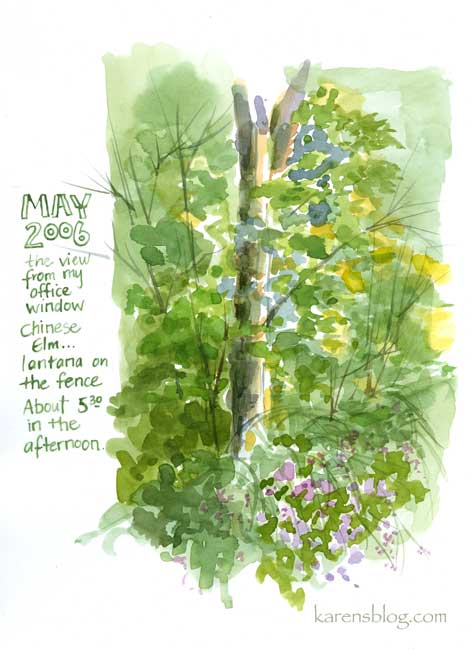
This is my return to the “Draw the view from your window” challenge. My intention is to do it for every season and to notice the differences in foliage and flowers. The tree is a Chinese elm, a hardy and vigorous grower that puts up suckers all over the yard, and promiscuously drops seeds with wild abandon. This elm, in fact, is a child of the four large elms that line the front of our property. Unlike American elms they are not vulnerable to Dutch elm disease. Come to think of it, they’re not vulnerable to anything – even severe trimming and drought. You couldn’t kill them if you tried, which makes them a good plant for drought prone areas like ours.
I painted this in my sketchbook this afternoon, looking out my window onto the end of a sunny day – a welcome change from all the rain and cloudy weather. The colors snapped, the light was good and I just had to stop what I was doing. But here’s my question: If you paint a nature scene from life but you’re not outside, can you call it plein-air? Should I call it faux-air? Or office-air? I am so confused; I will have to ruminate on this for awhile.
Edited to add:
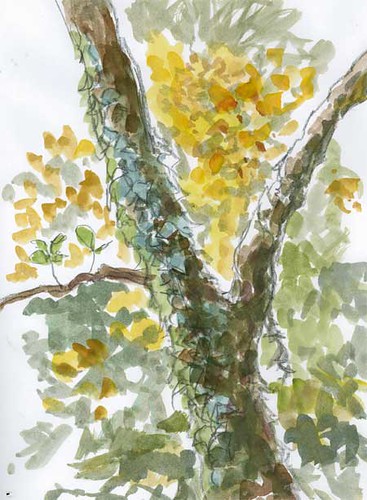
Here’s a fall window view …of the oak just to the left of the Chinese elm (elm not seen here.)
George
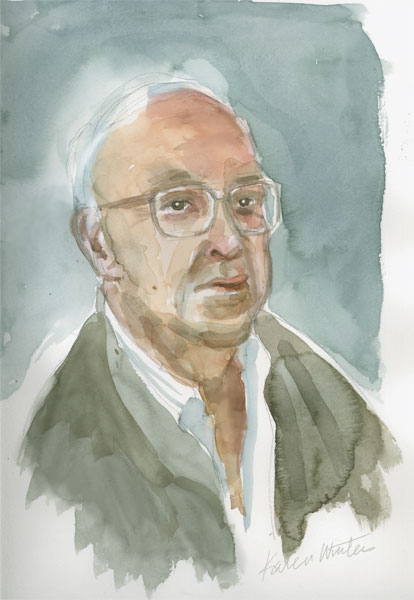
I got a late start but decided I would take part in Wet Canvas’ All Media Event. It’s a pretty interesting activity. Reference photos are posted over the weekend and you have a half an hour to select one and two hours to finish your piece (unless you don’t, and then you can post it as a work in progress.) This took me more than an hour, but less than an hour and a half, somewhere in there. I was working quickly – it’s little more than a sketch, really, but it was fun to do. You can execute your piece of work in any medium you want. I need practice in painting people so I picked this one and changed the background and attitude of the head to suit myself.
Yellow flag
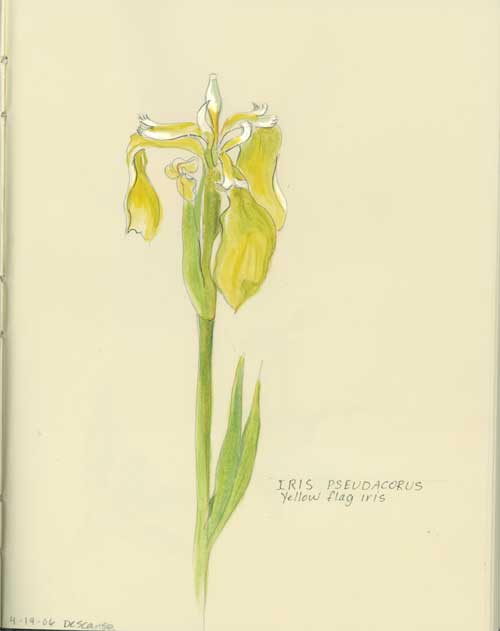
A recent entry in my ‘purely botanical’ sketchbook. This yellow flag iris is quite commonly planted around bogs or ponds. This one grows at Descanso gardens near a pond with a weeping willow. This iris, native to Asia and Europe, became known as the French fleur-de-lis, and the word “flag” may refer to a non-English word meaning rush or reed.
In some US states, pseudarcorus is considered a noxious weed because it grows by both underground tubers and reeds and can be invasive. We have a small patch of them in our yard and they have been very well contained in dry years. In very wet seasons they do spread a little bit.
Watercolor in a coptic bound Paperblanks journal with creamy paper
Three Sisters at the pool
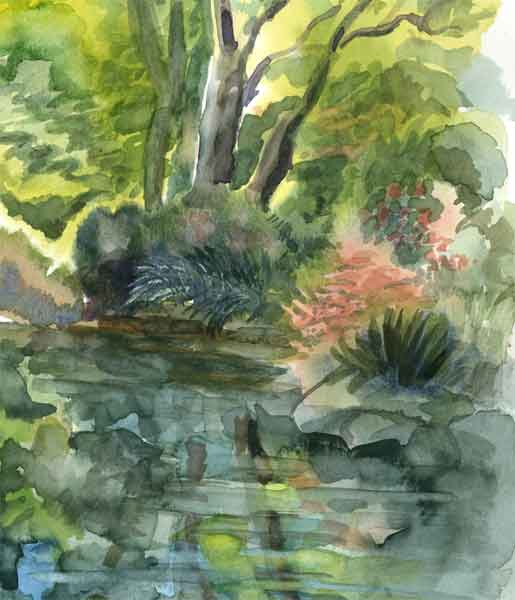
Descanso Gardens changes by the season, the day, sometimes by the minute. Especially when the morning sun is weaving and dodging through the dense canopy of oak trees. Yesterday I was so captivated by the morning light that I spent the first hour there shooting photos for reference. In the Japanese garden, one of my favorite areas, the light was changing so rapidly that even ten minutes might highlight a plant that had been in deep shade before. Not even enough time for a wash to dry before it utterly changed. When the light is steady – either full sun or full shade – this is not so much of a problem unless there are moving clouds. Take a look at a time lapse movie and the challenge of changing light will become readily apparent.
I tried cropping this differently, and I think I like it better.
Watercolor in a Canson Montval 7 x 10 watercolor field book
Arroyo Twilight
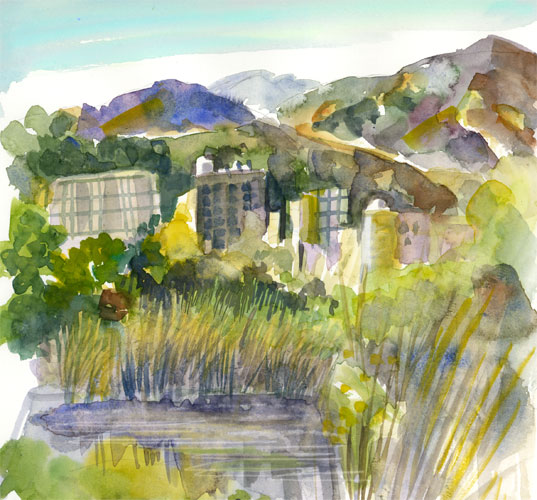
I think I tend to be a little too conservative with color. It’s a rut I’m trying to get out of by occasionally getting experimental and pushing the colors far beyond realism. So, today my husband and I went out for a little “golden hour” painting time – the last 25 minutes of the day before the sun went behind the nearby Verdugo Hills. There wasn’t time to fiddle and fuss about being neat or getting the shapes and values right – the light was changing rapidly by the minute. I had a very good time splashing around while he read to me about Calder from today’s LA Times.
This watercolor sketch is another view of the same arroyo I painted last week – an area that is either dustbowl dry or full of water depending upon the season. Right now there are cattails in a marshy area – redwinged blackbirds everywhere and ponds full of poliwogs. It’s my idea of a great painting location.
If you draw or paint, in what areas are you ‘pushing yourself’ to be more experimental, regardless of the outcome? Are you taking chances? How does it feel when you do?
Ripley again …
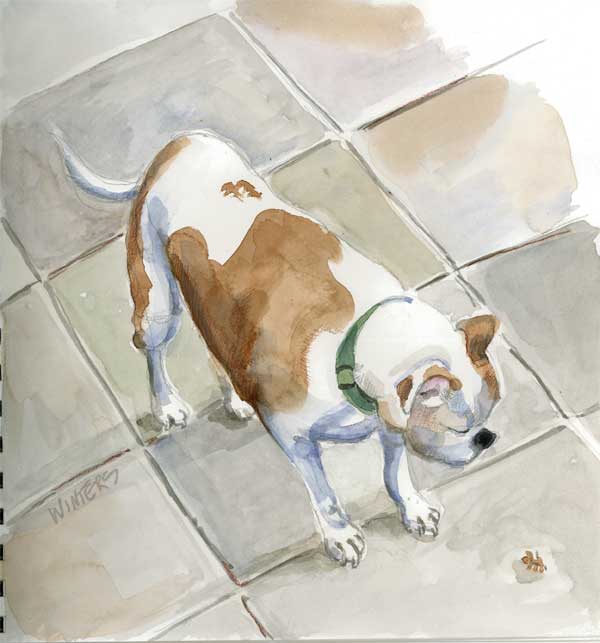
It’s been a few weeks since Ripley has made an appearance here and she was calling that to my attention earlier today. So here you are.
Because I know someone will ask, I will answer it ahead of time – I did not paint this from life. In fact, here’s the secret code to to figuring out whether a particular Rip-painting has been done from life. If Ripley is sleeping or lounging in a mostly horizontal position, there’s a good chance it was done from life. If she appears to be standing up, bouncing around, digging, begging, panting or wearing a plumed hat and pearls, there’s a good chance it was painted from a photo. I do sketch her from life a lot, but mostly when the switch is set to ZZZZZZZZZZZ.
Pasadena spring
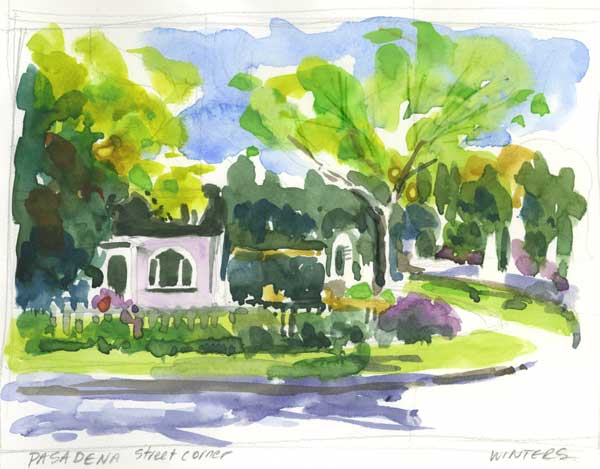
A watercolor sketch of a local streetcorner, influenced in part by a recent demo I saw by Joseph Stoddard, who is, himself, a student of Charles Reid. I think I’m going to be leaving the Niji waterbrushes behind for plein-air sketching, or else I’ll be using a lot more water for juicier washes.
Some leaf and flower studies

Last night, an art friend mentioned the book Botanical Illustration by Siriol Sherlock, and I pulled out my copy and read a little before going to bed.
Big mistake.
I turned fitfully and dreamed of impossible leaves and flowers and woke up in about two hours, probably due to Ripley snoring. But once awake, I couldn’t get those illustrations out of my mind. So I toddled down to my studio and studied some of the instructions, and then used some of my own reference photos to practice what I read on a scrap of watercolor paper. Modeling shiny surfaces wet in wet is going to take a lot of practice before I get any measure of comfort.
Do you ever get that way with an art project – where it grabs you and won’t let you go until you practice something or try something out?
Sketchcrawl at the Huntington
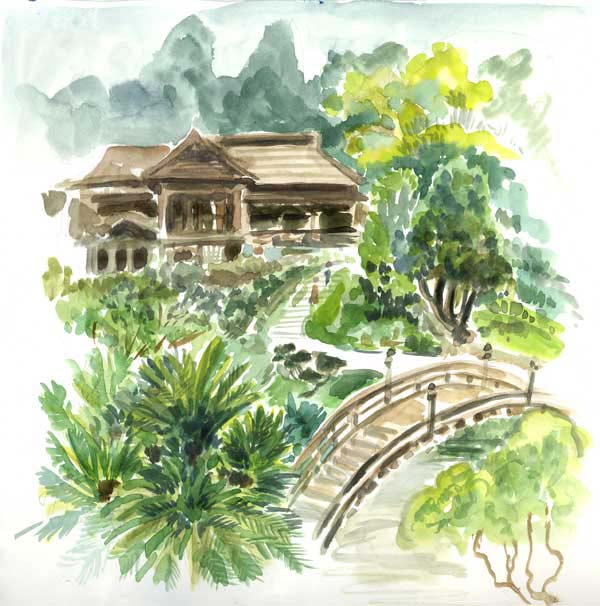
It was a spectacular spring day, not too warm, not too cool and all five of us (me, Nancy, Robin, Diann and Wendee) enjoyed the natural beauty of the Huntington for another memorable sketchcrawl. Our first stop was the Shakespeare garden (I’ll be scanning my sketch and posting it tomorrow or the next day) … second was the Japanese garden (this one), which was my favorite location of the day. We wrapped it up in the desert garden where we were joined by Diann’s husband and daughter.
As usual, many people stopped by to see what we were doing throughout the “crawl” and one journal keeper from Orlando showed us some of his watercolors as we compared notes about Niji waterbrushes and other traveling paint brushes.
This sketch was painted in about 45 minutes, give or take a bit. I stopped before painting the tree in the lower right hand corner or the water under the bridge so this is a “not quite finished” work in progress. So if you’re wondering why it looks like I just sort of stopped, it’s because I did. (smile)
I look forward to going back again soon and painting this garden from another vantage point, and to visit several other highlights as well. There’s just too much to take in all in a day. And then there’s the arboretum, too. We really do have a wealth of botanical gardens within a 20 minute drive. And I understand that the Getty’s gardens are overflowing with color, too.
Arty bits: painted in my super aquabee sketchbook with portable palette of tube paints and a Niji waterbrush.
White Poppy
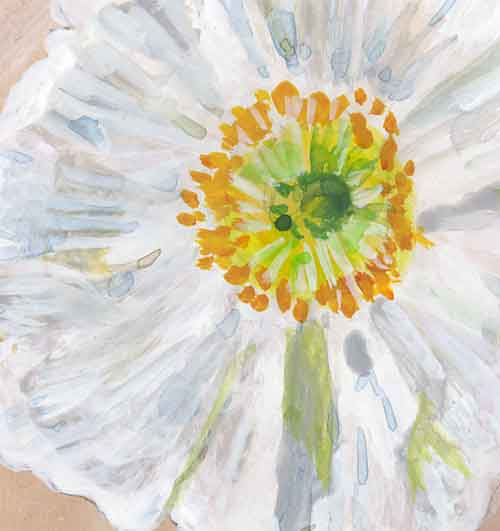
Someone please tell me what possessed me to try to paint white poppies on a Moleskine page previously toned with darker paint? As a first attempt with a difficult flower it would have made a lot more sense to use watercolor paper and reserve the whites. But no … I had to do it the bass ackward way. The background is all acrylic – a mixture of red, blue, yellow and white. Most of the white of the poppies is acrylic, the better to cover the mottled background. Then there’s some gouache in there for shadows, and more dilute acrylic on top.
These are Iceland poppies from (where else?) Descanso Gardens. I have some matilija poppies in a pot, and when they bloom I’ll give it another try.